



Facial Oils vs Moisturizers: What Your Skin Really Needs for Hydration and Glow
Confused about facial oils vs moisturizers and which one your skin actually needs? They serve completely different purposes — and using them incorrectly leads to dryness, breakouts, or no visible results. Moisturizers hydrate your skin; facial oils lock that hydration in. Used correctly together, they improve texture, strengthen the skin barrier, and deliver long-term glow.
Why Most Skincare Routines Get This Wrong
You're using good products. You're consistent. But your skin still feels greasy, dehydrated, or just stuck.
The problem isn't your products — it's a fundamental misunderstanding of how facial oils and moisturizers actually work together.
Most people make one of these mistakes: replace moisturizer entirely with oil, apply oil at the wrong step in their routine, or assume oil equals hydration. Understanding how to layer skincare products correctly is what separates a routine that works from one that doesn't.
The result of getting it wrong: skin that feels oily on the surface but remains dehydrated underneath, increased breakouts despite using "natural" ingredients, and no improvement in texture no matter how consistent the routine.
The most common misconception: "Facial oils can replace moisturizers." Oils do not add water to your skin — they seal what's already there. If your skin is dehydrated underneath, applying oil alone makes dryness worse over time. Think of it this way: moisturizer is the water supply, and oil is the lid that locks it in. Without water, the lid does nothing.
How Facial Oils and Moisturizers Actually Work
Your skin barrier depends on two things: hydration (water content) and occlusion (sealing that hydration in).
Moisturizers contain humectants like glycerin and hyaluronic acid that draw water into the skin, improve hydration levels, and repair the skin barrier over time. They absorb into the skin and work from within.
Facial oils contain lipids and fatty acids that sit on the surface, prevent water evaporation, and strengthen the outer barrier layer. They don't penetrate the way moisturizers do—they protect.
The correct sequence is hydration goes in first, and oil locks it in after. Skip either step, and the routine breaks down—no moisturizer leads to dehydration; no oil on dry skin leads to rapid moisture loss. This is why layering correctly matters more than choosing one product over the other.
Which Oil Do You Actually Need? (Honest Comparison)
Before adding any facial oil, it's worth understanding how common options compare—so your choice is based on your actual skin concern.
| Oil | Best For | Comedogenic Rating | Key Benefit |
|---|---|---|---|
| Grapeseed Oil | Oily, acne-prone, combination | Very low | Balances sebum, lightweight seal |
| Rosehip Oil | Dull, ageing, uneven tone | Low | Vitamin C, brightening |
| Jojoba Oil | Sensitive, dry, all types | Very low | Mimics skin's natural sebum |
| Argan Oil | Dry, mature skin | Low | Deep nourishment, anti-ageing |
For Indian skin in humid climates, grapeseed oil for oily skin is the most practical starting point—lightweight enough to wear daily without heaviness or breakouts and effective across most skin types.
5 Mistakes Blocking Your Results
1. Using Oil Instead of Moisturizer
Oil doesn't hydrate — it only seals. Without a moisturizer underneath, your skin stays dehydrated regardless of how much oil you apply.
2. Applying Oil Too Early
Oil blocks absorption of lighter products applied after it. It must always be the final step — after serum and moisturizer.
3. Using Heavy Oils on Oily Skin
Thick oils clog pores and trigger breakouts on oily or acne-prone skin. Lightweight, non-comedogenic oils like grapeseed are specifically suited for this skin type.
4. Skipping Oil Entirely on Dry Skin
Moisturizer alone hydrates but doesn't seal. Without an oil layer at night, hydration evaporates while you sleep, and skin feels tight again by morning.
5. Overusing Both Products
More product does not equal better results. Excess oil and cream combined clogs pores and creates heaviness. Two to three drops of oil are enough for the entire face.
Real Results: What Customers Experienced
★★★★★
"I had combination skin and was scared of oils. Switched to grapeseed oil after moisturizer at night. By week 3 my T-zone was noticeably less oily, and my cheeks stopped feeling tight in the morning."
— Priya, 29, Delhi★★★★★
"I was replacing my moisturizer with oil, thinking it was better. My skin felt greasy but still looked dull. Once I layered them correctly, texture improved within 2 weeks."
— Meera, 33, Bangalore★★★★★
"Humid weather made me avoid all oils. Grapeseed absorbed so fast I barely felt it. The skin barrier feels stronger, and I've had fewer breakouts in 6 weeks than in the entire past year."
— Ananya, 26, MumbaiWhere Grapeseed Oil Fits Into Your Routine
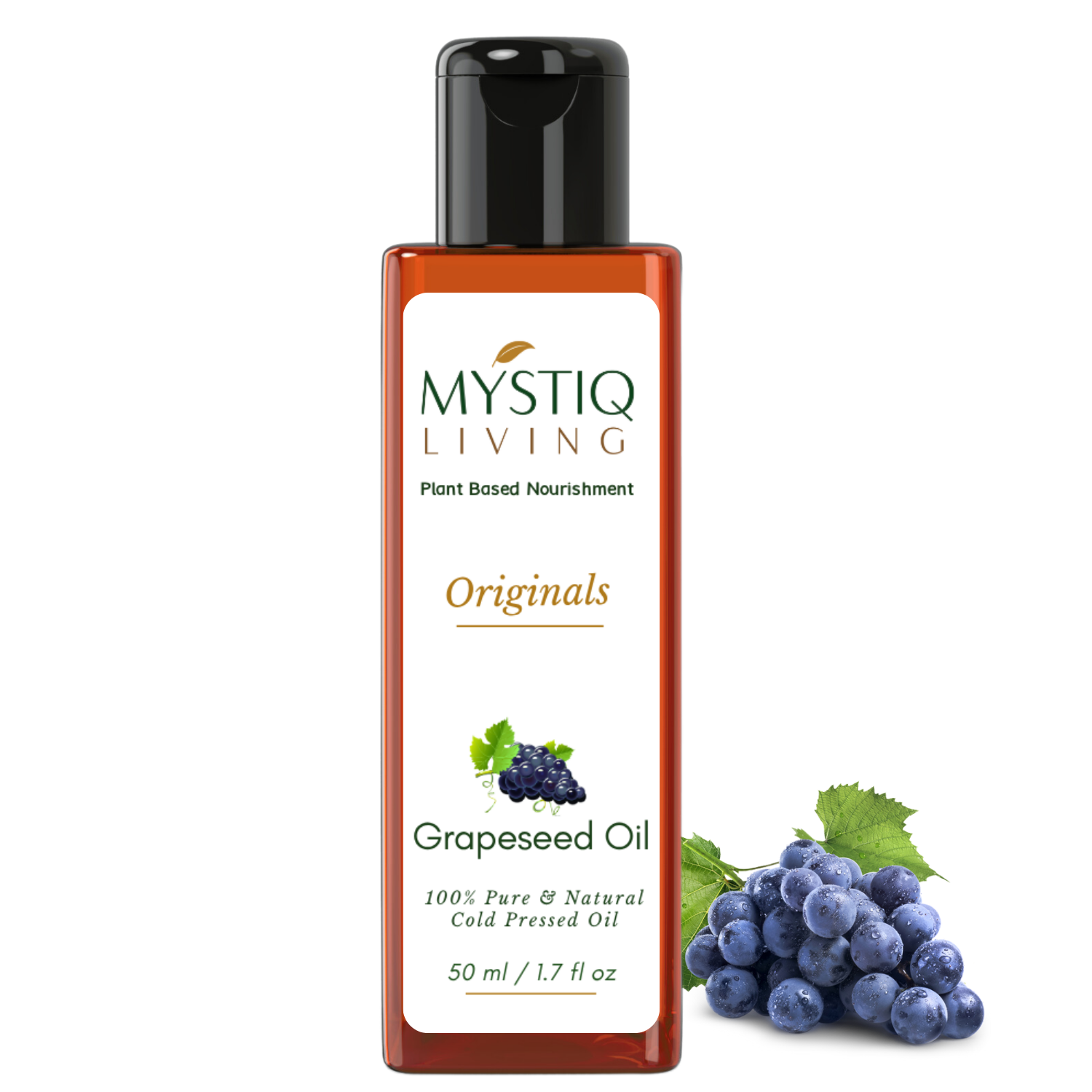
Mystiq Living Grapeseed Oil — cold-pressed, 100% pure, no additives. Lightweight, fast-absorbing, and non-comedogenic. Rich in linoleic acid, which specifically supports acne-prone and oily skin by helping regulate sebum production.
Unlike heavier oils that sit visibly on the skin, grapeseed oil absorbs quickly and seals hydration without greasiness—making it the most practical facial oil for Indian weather and humid climates.
Best for: Oily, combination, acne-prone, or dehydrated skin. Ideal as a first facial oil for beginners.
Use with caution if: If you have active cystic acne or are on prescription retinoids, consult a dermatologist first.
How to Layer Them Correctly
Morning Routine
Cleanse → Serum → Moisturizer → Sunscreen → (1–2 drops grapeseed oil only if skin feels dry)
Night Routine
Cleanse → Treatment serum → Moisturizer → 2–3 drops grapeseed oil as the final step
💡 Always apply oil on moisturized skin—never on a dry, unhydrated face.
⚠️ Never mix oil directly into your moisturizer — it reduces the effectiveness of both.
Realistic Results Timeline
| Timeline | What You'll Notice |
|---|---|
| Week 1–2 | Improved softness, reduced tightness after cleansing |
| Week 3–4 | Balanced oil production, smoother texture |
| Week 4–6 | Healthier glow, reduced dryness and flakiness |
| Week 6–8 | Stronger skin barrier, consistent long-term hydration |
Correct layering consistently outperforms expensive products used in the wrong order.
Myths vs Facts
| Myth | Fact |
|---|---|
| Oils can replace moisturizers | Oils seal moisture—they don't add it |
| Oily skin doesn't need facial oil | Lightweight oils balance sebum production |
| More oil gives better results | 2–3 drops is enough—excess clogs pores |
| Natural oils are always safe | The wrong oil type can worsen acne significantly |
Frequently Asked Questions
Q. Can I use facial oil without moisturizer?
A. Not recommended. Oil only seals what's already there—without a moisturizer underneath, skin stays dehydrated regardless of how much oil you apply.
Q. Which is better — facial oil or moisturizer?
A. Neither alone. They work as a system: moisturizer hydrates and oil seals. Use both in the correct order for real results.
Q. Can grapeseed oil cause breakouts?
A. It's one of the least comedogenic oils available, making it safe for most acne-prone skin types. Start with 1–2 drops and observe your skin's response over two weeks.
Q. Morning or night—when should I use facial oil?
A. Night is ideal for most people. Lightweight oils like grapeseed can be used in the morning in small amounts, but avoid layering under sunscreen unless your skin is very dry.
Final Takeaway
Facial oils vs moisturizers isn't a choice—it's a sequence. Moisturizers hydrate. Oils seal. Together, in the right order, they create a routine that actually works long-term.
If your skincare isn't delivering results, the problem is almost certainly the layering—not the products themselves. Fix the order, choose the right oil for your skin type, and keep it simple.
Healthy skin comes from better layering, not more products.
Skin is a living ecosystem.
Not a problem to be corrected.
While the beauty industry pushes stronger acids and aggressive actives, the real cost is skin that becomes reactive, dependent, and sensitive over time. We've taken a different path — one that works with your skin, not against it.