



"100% Natural" Skincare in India: How to Identify What's Truly Clean
The biggest confusion in today's beauty market is understanding what natural skincare in India actually means. Many products use the label for marketing, not purity. Learning to read ingredient lists, understand extraction methods, and spot clean formulations helps you avoid hidden chemicals and choose products that genuinely support your skin.
Why "Natural Skincare" Is So Confusing in India
Walk into any beauty store or browse online, and almost every product claims to be "natural," "herbal," or "chemical-free."
Here's the reality: these terms are not regulated in India.
Knowing how to read skincare ingredients is the only reliable way to know what you're actually putting on your skin. Brands can use a small percentage of natural ingredients, add synthetic fillers or artificial fragrance, and still label the product "100% natural." The result is consumers who believe they're using clean skincare, skin that reacts unexpectedly, and long-term skin health that never actually improves.
A product with neem or aloe on the front label may still contain parabens. An "Ayurvedic" oil may be diluted with mineral oil. An "herbal" cream may be preserved with synthetic chemicals. The packaging looks natural. The formulation isn't.
The biggest misconception: "If it says natural, it must be safe."
In reality, the ingredient list tells the truth. The front label is marketing.
What "Truly Clean" Skincare Actually Means
"Clean" skincare isn't defined by what a brand claims—it's defined by what's actually in the product.
A truly clean formulation has three qualities: ingredient transparency (a clear, readable INCI list), minimal processing (cold-pressed or steam-distilled, not heat-extracted), and no harmful additives like synthetic fragrance, parabens, or mineral oil.
Important: not all chemicals are bad. Everything — including water — is technically a chemical. The problem isn't chemicals; it's harmful or unnecessary ones. What matters is the source of ingredients, the extraction method, and the purity level.
The ingredient order rule: ingredients are listed in descending order of concentration. If a "natural" ingredient like aloe or neem appears near the bottom of a long list, it's present in a negligible quantity—often less than 1%. This is how most brands create the illusion of natural skincare while keeping synthetic fillers as the primary base.
Truly Natural vs Marketed "Natural": The Real Difference
| Feature | Truly Natural Skincare | Marketed "Natural" Skincare |
|---|---|---|
| Ingredients | Minimal, transparent, recognisable | Mixed with synthetic fillers |
| Fragrance | Natural or fragrance-free | Artificial fragrance added |
| Processing | Cold-pressed or steam-distilled | Heat-processed, nutrients lost |
| Label Claims | Honest, specific, sourcing explained | Vague, aggressive, unverifiable |
| Key Ingredient Position | Top of ingredient list | Bottom — negligible quantity |
| Long-term Results | Visible skin health improvement | Temporary surface-level results |
The most reliable signal of a truly clean product: the brand explains how their ingredients are sourced and processed, not just what they contain.
5 Mistakes People Make When Choosing Natural Skincare
- Trusting front-label claims: "100% Natural," "Herbal," and "Ayurvedic" are marketing terms, not regulated certifications in India. Always skip the front and read the INCI ingredient list directly.
- Ignoring ingredient lists entirely: Hidden irritants like synthetic fragrance, PEG compounds, and mineral oil go unnoticed when ingredient lists aren't checked. Learning to identify five common red-flag ingredients is enough to make significantly better choices.
- Assuming price equals purity: Expensive products are not automatically cleaner. Many premium brands use the same synthetic base as budget products with a more sophisticated label. Price reflects marketing spend — not ingredient quality.
- Applying natural ingredients without matching to skin type: Even genuinely natural ingredients can cause reactions if they don't suit your skin. Coconut oil clogs pores for acne-prone skin. Heavy botanicals irritate sensitive skin. Natural doesn't automatically mean compatible.
- Not checking the extraction method: How an oil is made determines how effective it is. Cold-pressed oils retain their active compounds. Heat-processed oils lose the nutrients that make them worth using. Steam-distilled essential oils preserve potency. This detail is rarely on the front label — you have to look for it.
Real Results: What Customers Experienced After Switching to Truly Clean Products
★★★★★
"I was using an 'Ayurvedic' face oil for 6 months with no results. Checked the ingredients — mineral oil was listed second. Switched to a cold-pressed pure oil, and my skin texture improved within 3 weeks."
— Priya, 28, Delhi★★★★★
"My 'natural' moisturizer was causing breakouts. Found synthetic fragrance listed fourth in the ingredients. Removed it from my routine, and breakouts reduced within 2 weeks without changing anything else."
— Meera, 32, Mumbai★★★★★
"I assumed expensive meant clean. Started reading labels and realized my premium serum had parabens. Switched to simpler, verified clean products, and my skin stopped reacting within a month."
— Ananya, 25, BangaloreWhere Tea Tree Oil Fits as a Clean Skincare Standard
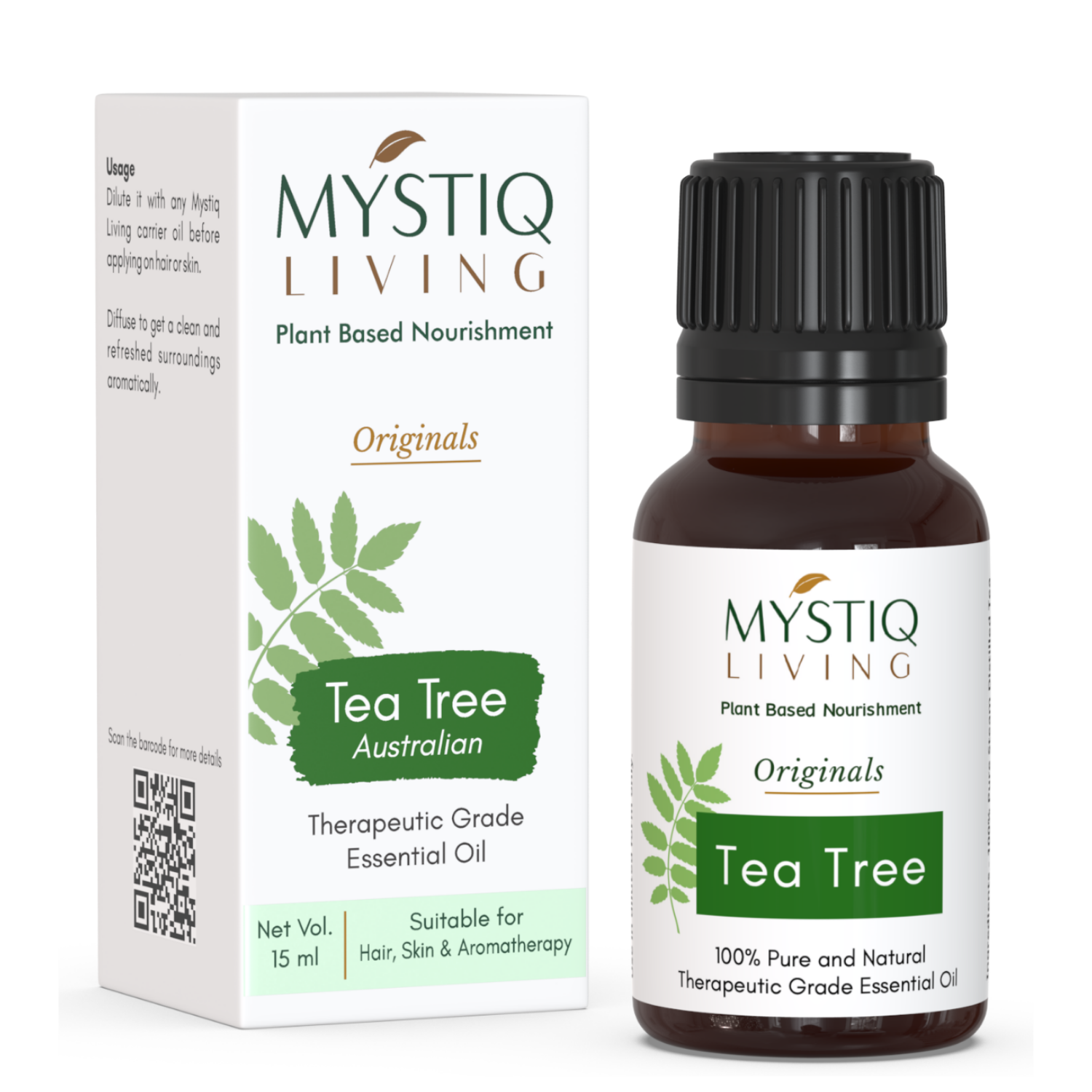
If you want a clear example of what truly clean looks like in practice, pure tea tree essential oil is the benchmark.
Mystiq Living Tea Tree Essential Oil—100% pure, steam-distilled, with no fillers or synthetic additives. One ingredient. One clear extraction method. Nothing hidden.
Using tea tree oil for acne works as a targeted spot treatment because it addresses bacterial imbalance at the root—without the synthetic preservatives, artificial fragrance, or comedogenic fillers found in most marketed "anti-acne" creams.
How to use: always dilute 2 drops in 1 teaspoon of carrier oil before applying to skin. Never use it undiluted directly on the face.
- Best for: acne-prone, oily, and combination skin — effective as a spot treatment or mixed into your routine
- Use with caution if: you have sensitive skin or known essential oil allergies—patch test first
How to Read a Label in 60 Seconds
- Skip the front — go straight to the ingredient list
- Check the first five ingredients—these make up 80%+ of the product
- Look for red flags: synthetic fragrance, parabens, mineral oil, PEG compounds
- Find the "hero" natural ingredient—if it's near the bottom, it's barely present
- Check for extraction method—cold-pressed or steam-distilled signals quality
💡 If a product promises instant results, it's almost certainly not truly natural. ⚠️ "Chemical-free" is scientifically impossible—it's a marketing phrase, not a safety claim.
Realistic Results Timeline After Switching to Clean Skincare
| Timeline | What You'll Notice |
|---|---|
| Week 1–2 | Reduced irritation, better skin tolerance to routine |
| Week 3–4 | Fewer breakouts, improved texture, less redness |
| Week 5–6 | Balanced, healthier skin with long-term visible glow |
Clean skincare works gradually—the absence of irritants allows skin to stabilize and self-correct over time.
Myths vs Facts
| Myth | Fact |
|---|---|
| Natural skincare is always safe | Natural ingredients can still cause reactions if misused or mismatched |
| Chemical-free products exist | Everything is a chemical—focus on safe, necessary ones |
| Herbal products don't need ingredient checks | Many contain synthetic additives as primary ingredients |
| Instant results mean better products | True skincare works gradually—fast results often signal harsh actives |
Frequently Asked Questions
Q. How can I tell if a product is truly natural?
A. Read the INCI ingredient list. Look for minimal, recognizable ingredients, no synthetic fragrance, and a clearly stated extraction method. Brands that are genuinely clean highlight sourcing — not just claims.
Q. Why do some natural products still cause breakouts?
A. Usually due to hidden synthetic fragrance, comedogenic fillers, or a natural ingredient that doesn't suit your skin type. Checking both the ingredient list and your skin's individual compatibility prevents this.
Q. Is switching to natural skincare enough?
A. Switching helps — but correct technique and consistent use matter equally. Natural products work best when layered correctly and chosen based on your specific skin concern.
Q. What's the single most important label check?
A. The position of the hero ingredient. If neem, aloe, or any promoted natural ingredient appears in the bottom third of the list, its concentration is too low to be meaningful.
Final Takeaway
The natural skincare truth in India is straightforward: labels don't define purity; ingredients do. The front of the pack is marketing. The ingredient list is the truth.
Build your routine around products where you can verify every ingredient, understand the extraction method, and trust the formulation—not the claim.
Skin is a living ecosystem.
Not a problem to be corrected.
While the beauty industry pushes stronger acids and aggressive actives, the real cost is skin that becomes reactive, dependent, and sensitive over time. We've taken a different path — one that works with your skin, not against it.